What is AI?
Some tasks are easy for computers to perform, such as:
- Identifying the maximum number in a dataset
- Calculating the shortest route from your office to the subway station
For these types of problems, we can provide clear, step-by-step instructions that computers execute reliably. However, other tasks are much harder to solve with traditional programming:
- Is this person happy?
- Is that a cat in this image?
While these questions might seem straightforward for humans to answer, they’re surprisingly difficult to program explicitly. Artificial Intelligence (AI) refers to systems that can perform tasks typically requiring human intelligence — such as recognizing patterns, understanding language, and making decisions based on complex data.
Rather than following rigid instructions, AI systems learn from examples and experience, allowing them to handle tasks that are difficult or impossible to solve with conventional programming alone.
What is Machine Learning?
Machine learning is a subset of AI where computers learn patterns from data rather than following explicit instructions. A machine learning system analyzes examples, identifies patterns, and uses what it has learned to make predictions or decisions about new, similar data.
The key difference from traditional programming:
-
Traditional Programming: You provide explicit rules → the computer follows them → produces output
- Analogy: Following a recipe step-by-step to cook a meal
-
Machine Learning: You provide examples (data) → the computer finds patterns → creates a model that can handle new situations
- Analogy: Tasting a dish at a restaurant and figuring out the ingredients and techniques (recipe) to recreate it at home
For instance, instead of writing rules like “if the email contains the word ‘prize’ and asks for personal information, it’s spam,” a machine learning system learns what spam looks like by analyzing thousands of examples of spam and legitimate emails, then identifies patterns we might never have thought to program explicitly.
AI, Machine Learning & Deep Learning
You’ve probably heard these terms used interchangeably, but they’re actually nested concepts:
- Artificial Intelligence (AI) is the broadest concept — any technique that enables computers to mimic human intelligence
- Machine Learning (ML) is a subset of AI—systems that learn from data without being explicitly programmed
- Deep Learning (DL) is a subset of Machine Learning — uses neural networks with multiple layers to learn complex patterns
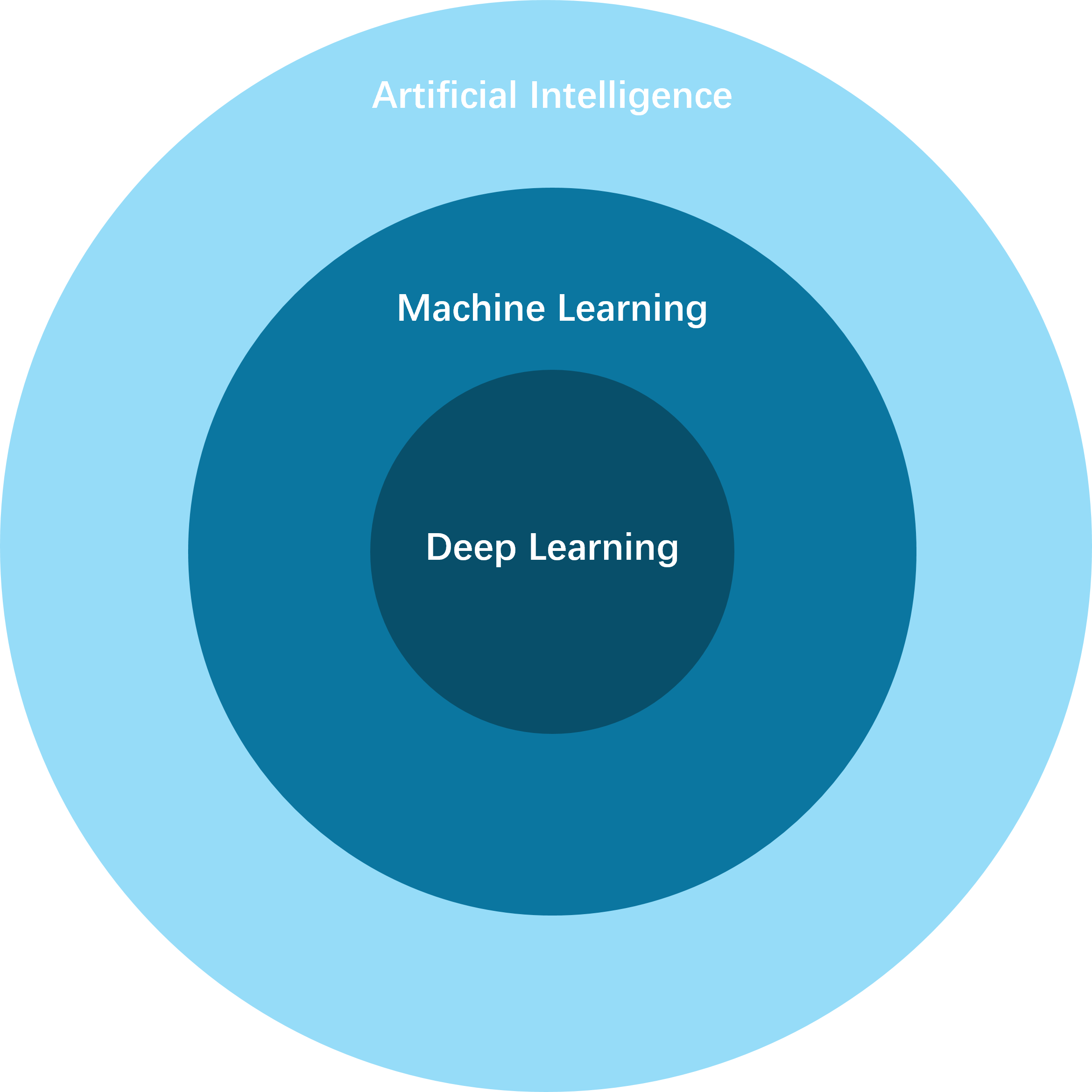
Example to illustrate the difference:
- AI: A chess-playing computer (could use rule-based logic or learning)
- Machine Learning: A spam filter that improves by analyzing thousands of emails
- Deep Learning: Image recognition that identifies cats in photos by learning from millions of images through neural networks
AI vs. Data Science
While AI and Data Science both work with data and often use similar tools, they have different primary goals:
| Aspect | AI | Data Science |
|---|---|---|
| Primary Goal | Enable machines to perform intelligent tasks (perception, reasoning, decision-making) | Extract insights and knowledge from data to inform decisions |
| Focus | Automating intelligent behavior | Understanding patterns and answering questions |
| Key Techniques | Machine learning, neural networks, computer vision, natural language processing | Statistics, data analysis, machine learning, visualization |
| Typical Output | A system that performs tasks (chatbot, recommendation engine, autonomous vehicle) | Insights, reports, predictions, dashboards |
| Example Applications | Virtual assistants (Siri, Alexa), self-driving cars, facial recognition | Customer churn analysis, sales forecasting, A/B testing, market research |
The overlap: Data scientists often use AI/ML techniques, and AI systems require data science skills to prepare and analyze data. Many professionals work at the intersection of both fields.
Common AI Terms Explained
As AI evolves rapidly, new terminology emerges constantly. Here are some current buzzwords simplified:
-
LLM (Large Language Model) - AI systems trained on massive amounts of text that can understand and generate human - like language. Examples: ChatGPT, Claude, GPT-4. Think of them as extremely well-read assistants that can write, answer questions, and help with various language tasks.
-
Agent - An AI system that can take actions autonomously to achieve goals, not just respond to questions. Unlike a basic chatbot that only answers when asked, an agent can plan multiple steps, use tools, and complete complex tasks with minimal human supervision. Example: an AI that researches a topic, writes a report, and emails it to you.
-
MCP (Model Context Protocol) - A standard way for AI systems to connect with external tools and data sources. It’s like giving your AI assistant the ability to check your calendar, access your files, or pull data from various apps—all through a unified interface.
-
Skill - A specialized capability or function that an AI system can perform, often by connecting to specific tools or following particular workflows. Think of skills as apps for your AI—each one teaches it how to do something specific like analyzing spreadsheets, generating images, or searching databases.
-
RAG (Retrieval-Augmented Generation) - A technique where AI retrieves relevant information from a knowledge base before generating a response, making answers more accurate and up-to-date. It’s like giving the AI a library to reference instead of relying only on what it memorized during training.
-
Fine-tuning - Customizing a pre-trained AI model for specific tasks or domains by training it further on specialized data. Like teaching a general doctor to become a heart surgeon — the foundation is there, but you add expertise in a particular area.
MCP vs. Skill: What’s the Difference?
These terms are related but serve different purposes:
| Aspect | MCP (Model Context Protocol) | Skill |
|---|---|---|
| What it is | The connection standard or “language” that lets AI communicate with external systems | The actual capability or know-how that AI uses to accomplish specific tasks |
| Analogy | The USB port on your computer | The USB device you plug in (printer, camera, keyboard) |
| Technical role | Infrastructure/protocol layer | Application/capability layer |
| Example | The protocol that allows Claude to connect to Google Drive | The “document editing skill” that knows how to read, analyze, and modify Word files |
| Focus | How AI connects to tools | What the AI can do with those tools |
In practice: An AI system might use MCP to connect to various services (email, calendar, databases), and then use different skills to actually work with the data from those services — like a “meeting scheduler” skill or “data analysis” skill. MCP is the bridge; skills are what you accomplish after crossing it.